
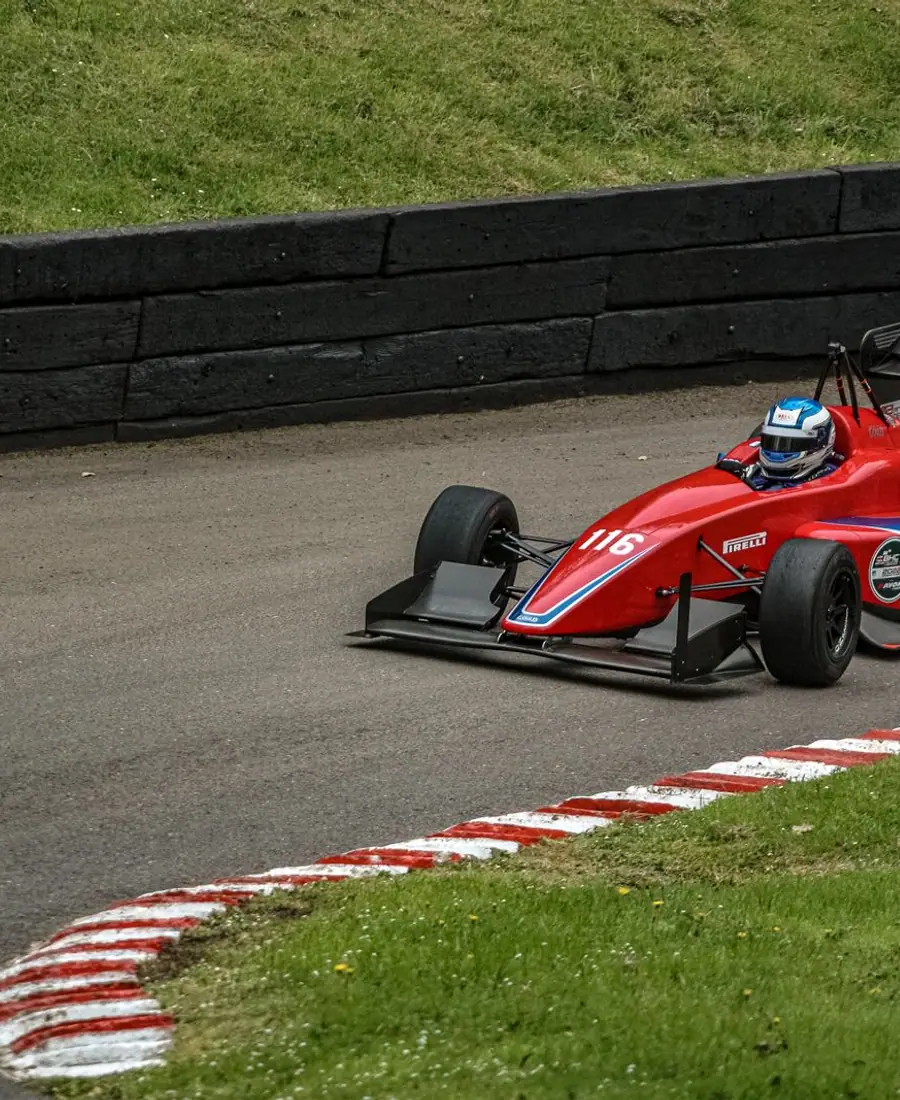
Race day gets the crowds and the trophies, but a strong case can be made that IndyCar qualifying is the harder examination. It asks for something the race never quite does: everything, all at once, with no second chances and nowhere to hide. And it comes in two very different flavours.
The knockout format
On road and street courses, qualifying is run as a series of knockout rounds. The full field goes out, the slowest are eliminated, and the survivors advance to progressively smaller, faster sessions until a final shootout decides pole. Each round is short, so there is no time to build up. You have to be on the absolute limit almost immediately, on a track that is often still evolving beneath you.
The format punishes hesitation. Bank a lap too cautiously to be safe, and you may not get another warm enough tyre or clear enough track to improve. Overdrive it and lock up, and your lap is gone. The margin between advancing and being knocked out is frequently a few hundredths of a second, less than a blink.
The single-lap tightrope
What makes qualifying so different from the race is the absence of margin. In a race you manage tyres, fuel, and position over a distance; a mistake in one corner can be recovered in the next fifty. In qualifying there is no next fifty. A single lap, or a small handful, has to be perfect: every braking point on the edge, every apex clipped, every exit maximised, on tyres that give their best for only a lap or two before fading.
A race rewards the driver who makes the fewest mistakes over two hours. Qualifying rewards the one who makes none in ninety seconds. Those are different talents.
Indianapolis breaks the mould
And then there is the Speedway, which throws the whole format out. Qualifying for the Indianapolis 500 is not a single lap but four consecutive laps, ten miles, with the average of all four setting your time. It is a uniquely cruel test. You cannot nail one corner and coast; you have to hang the car on the edge for ten straight miles, trimmed out for minimum drag and maximum speed, in a car that is deliberately made nervous to find that last mile per hour.
Four perfect laps in a row, with the car set up to frighten you, is one of the purest tests of nerve in motorsport. The pressure is enormous, and it compounds: a small error on lap one taints the average you spend the next three laps trying to rescue.
Why qualifying is its own skill
Some drivers are demons on a single lap and merely good in a race; others are the reverse. That is not a contradiction. It reflects that qualifying is a genuinely distinct discipline. It rewards a specific kind of nerve: the willingness to commit absolutely when there is no margin for error and no chance to make it back.
So do not treat qualifying as a warm-up act. It sets the grid that shapes the race, yes, but it is also, on its own terms, one of the most demanding things a driver is asked to do all weekend. Two laps, or four, no mercy, and nowhere to hide.