
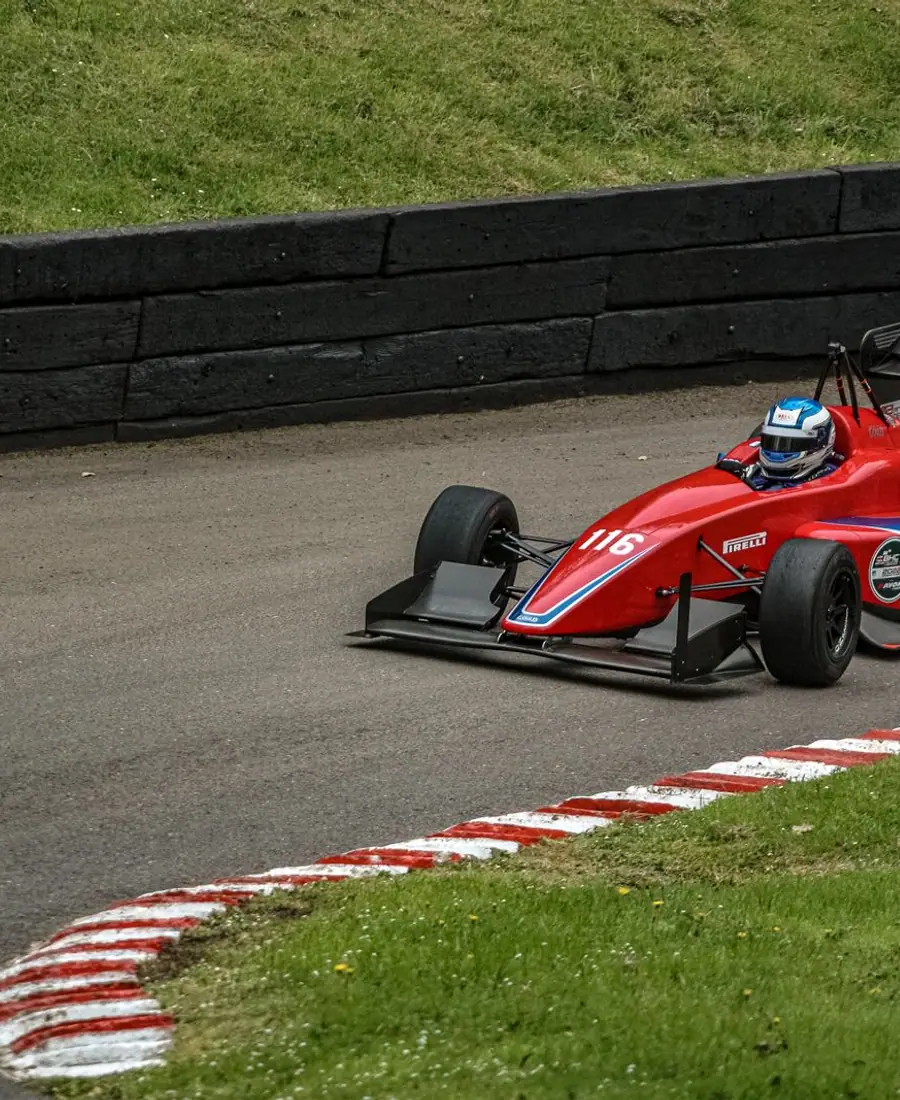
High above an IndyCar oval, on a rooftop or a grandstand perch, stands one of the most important people in a driver's race, someone who never touches the car and whose entire job is to talk. The spotter is the driver's eyes where the driver has none, and on an oval, they are the difference between a clean race and a wall.
The perch
A spotter is positioned high above the track with a clear view of the whole circuit, or a critical portion of it. From the cockpit, a driver's vision is brutally limited. Mirrors are small, blind spots are enormous, and at 220 mph the car ahead can be swallowed by the one behind. The spotter fills that gap in real time, feeding the driver a running picture of where every threat is.
The language
Spotting is a craft of compression. There is no time for sentences, so a good spotter develops a clipped, unambiguous shorthand that a driver can absorb without thinking:
- "Clear", the space beside you is empty; you can move.
- "Inside" or "outside", a car is there; do not move into it.
- "Three-wide, you're the middle", the worst sentence in oval racing, delivered calmly.
Every word is chosen to reduce a chaotic, high-speed picture to a single instruction the driver can act on instantly. Say too much and you drown the driver in noise. Say too little and they move blind. The rhythm is everything.
The best spotters are not the ones who talk the most. They are the ones who say the exactly right word at the exactly right instant, and stay silent the rest of the time.
Ovals versus road courses
The spotter's role peaks on ovals, where cars run in tight packs at colossal speed and a driver genuinely cannot see the car tucked beside their rear wheel. There, the spotter is a safety-critical position, and a missed call is a crash. On road and street courses the job shifts toward strategic information: warning of incidents ahead, tracking rivals through a lap, relaying flags on a circuit too long to see all at once. Different tracks, same core value: giving the driver information they physically cannot gather themselves.
Trust
What makes the relationship work is trust built over time. A driver committing to a three-wide move at 220 mph is, in that instant, trusting the spotter's word with their life. That trust cannot be improvised. It is why teams keep driver-spotter pairings together for years, learning each other's rhythm, tone, and tells until the communication is almost telepathic.
You will almost never see the spotter on the broadcast. They are a voice, a name in the credits, a figure on a distant rooftop. But listen to team radio during a close oval finish and you will hear the job in its purest form: a calm human, high above the chaos, turning what they can see into words fast enough to keep a driver both racing and alive. It is one of the sport's most invisible skills, and one of its most indispensable.