
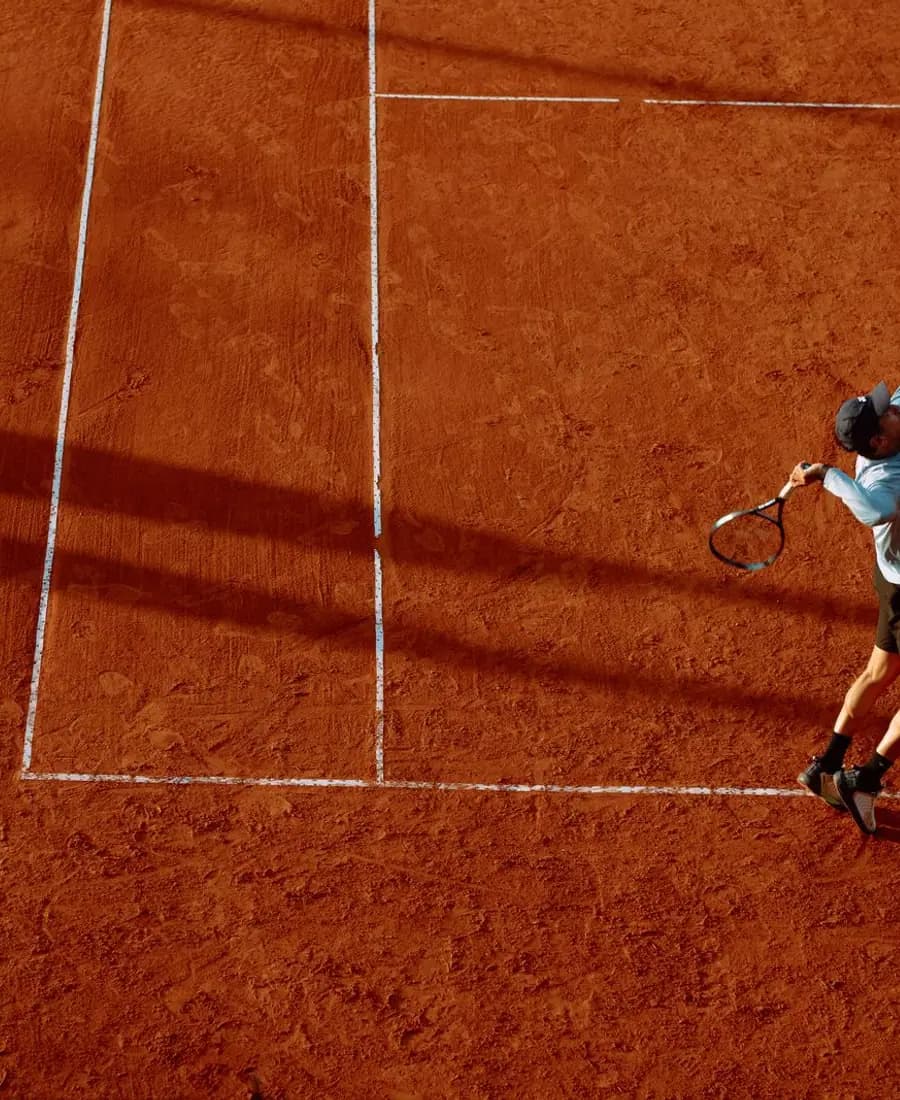
The calendar hands professional tennis its cruelest joke every summer. A player can win seven best-of-five matches on the slowest surface in the sport, then be asked to contest the fastest one roughly ten days later. Nothing else in elite sport demands a comparable rebuild of technique, timing and instinct in so little time.
Two surfaces, two different games
Clay and grass are not variations on a theme. They are opposite arguments about what tennis should reward.
Clay is slow and high-bouncing. It rewards patience, heavy topspin, and the willingness to construct a point over eight, ten, twelve shots. Sliding into the ball is not just allowed, it is the correct way to move. The surface forgives a step out of position because there is always time to recover.
Grass is fast and low. The ball skids and stays under hip height, which punishes the big looping topspin that dominates on clay. Points are short. First-strike tennis rules: whoever dictates with the serve and the shot after it usually wins the point before a rally can even form.
On clay, you earn the point. On grass, you take it, or it gets taken from you.
What the body has to unlearn
Movement is the hidden battleground. A clay-court specialist spends a month training the slide, planting the outside foot and letting the surface do the braking. On grass, that same slide is a trapdoor. The footing is slick early in the tournament and grippy once the baseline wears bare, so players shorten their steps, lower their stance, and rely on quick split-steps instead of long recoveries.
The knees hate it. Bending to reach low, skidding balls after a month of upright, high-bounce clay rallies is a genuine physical shock, which is one reason first-week grass upsets happen so often.
Rebuilding the serve and the return
The serve gains value on grass because the surface amplifies it. A flat serve that sits up invitingly on clay becomes nearly unplayable when it skids off the grass. Smart players adjust their patterns:
- More flat and slice serves, fewer heavy kickers that bounce into the strike zone
- A deliberate slice out wide to open the court, because the low bounce makes the return defensive
- Serve-and-volley returns as a surprise, since the short point structure rewards closing the net
Returners, meanwhile, move up. On clay you can stand four feet behind the baseline and still handle a big serve because the bounce buys you time. On grass, that same position leaves you lunging at your shoelaces. The return becomes a block and a redirect rather than a full swing.
Why some players never make the jump
The transition explains why the sport produces clay specialists and grass specialists who rarely overlap at the very top. Adapting requires a flatter ball, an appetite for shorter points, and a comfort with risk that patient clay-courters spend months suppressing.
The players who conquer both are the ones who treat the transition as a change of language, not a change of accent. They do not try to play grass tennis with clay habits. They accept that the winning shot in Paris is often the losing shot at Wimbledon, and they rebuild accordingly, in ten days, under the brightest lights the sport offers.