
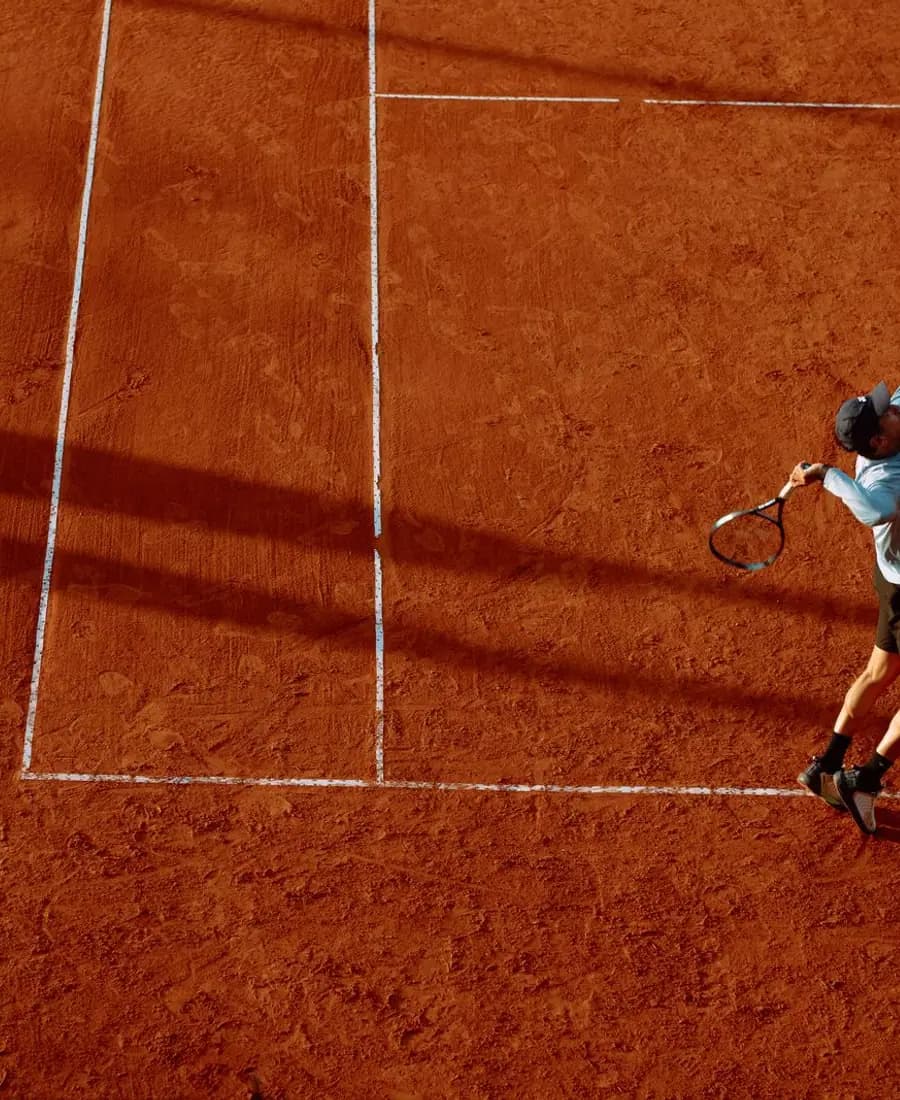
Watch a great mover and the overwhelming impression is of ease. They never seem rushed, never seem to sprint, always arrive with time to spare. That ease is an illusion built from a stack of tiny, trained mechanics. Movement is a craft, and like all crafts, its mastery lives in details the audience is not meant to see.
Movement is not running
The first myth to kill: tennis movement is barely about straight-line speed. A player who wins the hundred metres would be lost on a tennis court, because the sport almost never asks for a long sprint. It asks for explosive first steps, constant changes of direction, and the ability to stop and rebalance in a fraction of a second.
The fastest player is not the best mover. The best mover is the one who gets to the ball balanced, with a full swing available, and recovers in time for the next one.
The split-step: the invisible engine
Everything begins with the split-step, the small hop a player makes as the opponent strikes the ball. It looks like a nervous tic. It is actually the most important movement in tennis.
The split-step loads the legs and lands the player on the balls of their feet just as the ball leaves the opponent's racquet, so they can push off instantly in any direction. Time it right and the first explosive step comes for free. Time it wrong, or skip it, and every ball feels a half-second late.
Amateurs think they were slow to the ball. Usually they were just late off the split-step.
The slide, and why it is a skill
On clay, and increasingly on hard courts, the slide is not a loss of control. It is a controlled deceleration. Instead of stamping to a stop, which is jarring and slow to recover from, the player lets the outside foot skid, using friction to brake smoothly into the shot.
The genius of a good slide is that it merges the stop and the hit. The player arrives, brakes, and swings in one flowing motion, then uses the momentum of the slide to spring back toward the middle. Learning to slide on a hard court, where the surface grips more than clay, is one of the defining movement skills of the modern game.
Recovery: the half nobody watches
Here is the most underrated idea in movement. Getting to the ball is only half the job. The other half, the recovery step, is what separates a one-time save from sustained defense.
Elite movers begin recovering before they have even finished the shot, using a small cross-step or a shuffle to reset toward the optimal court position for the reply they expect. Casual players admire the reach. Coaches admire the recovery, because that is what lets a player defend the next ball, and the one after that.
Putting the craft together
Stack these pieces and the effortless look finally makes sense:
- Split-step to load and react on time
- Explosive first step in the read direction
- Efficient path to the ball, curved if needed, never wasted
- Controlled slide or plant that merges braking with the swing
- Immediate recovery back toward center before the shot even finishes
None of it is visible as effort, which is exactly the point. The player who makes movement look easy has simply hidden the labor inside a hundred small, trained decisions. Learn to see those decisions, and you will never watch footwork the same way again.