
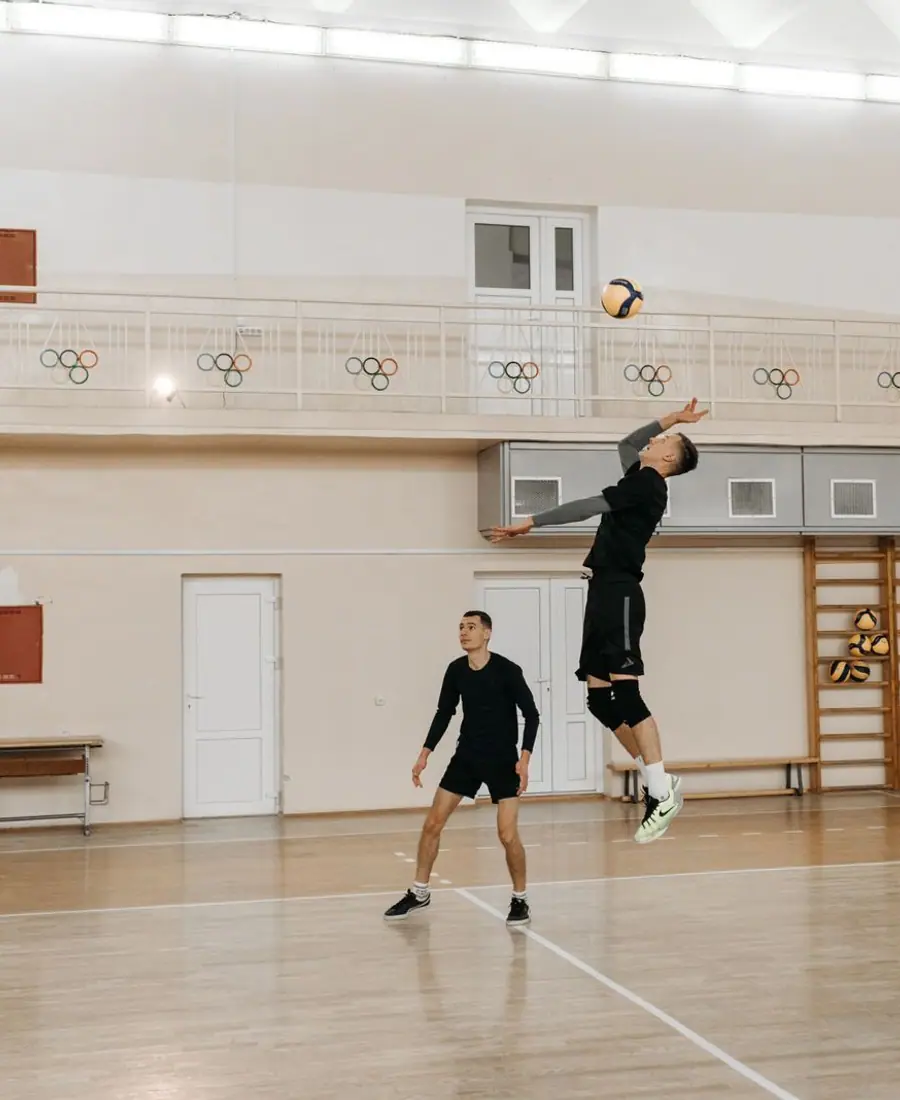
If you have ever watched volleyball and wondered why players scatter to completely different spots the moment the ball is served, you have run into rotations. It looks like chaos. It is actually one simple rule producing complicated-looking results.
One rule to understand it all
Here is the rule. At the instant the server contacts the ball, each player must be in the correct order relative to their neighbors. Front-row players must be in front of their corresponding back-row players, and left-middle-right order must be preserved across the row. That is it. This is called the overlap rule.
Crucially, the rule only applies at the moment of the serve. The instant the ball is struck, everyone is free to sprint wherever they need to be. That single loophole explains almost everything strange you see on court.
Why players stand in odd places
Because the rule only checks positions at contact, teams line up in awkward, bunched formations that are legal for one frozen instant and then dissolve. A setter who needs to be at the front-right will stand as close to that spot as the overlap rule allows, even if it means crowding a teammate, so they have the shortest possible sprint to their setting position once the serve is away.
- The setter releases to their target the instant the ball is served.
- Hitters slide out to their approach lanes.
- The libero and passers spread into serve-receive.
All of that motion is legal precisely because it happens after contact.
Six rotations, one lineup
A team rotates clockwise by one position every time it wins the serve back from the opponent. Over a full cycle, every player passes through all six positions, which means everyone must serve and everyone spends time in both the front and back rows.
Rotations are volleyball's fairness engine. No one hides in the front row all match, and no one avoids serving. Every skill is exposed eventually.
This is also why you hear about a team's strong rotation and weak rotation. In some rotations a team has its best attackers in the front row and its best passer receiving. In others, the deck is stacked awkwardly, maybe the setter is stuck in the back-right corner and has to travel a long way. Good teams script solutions for their weak rotations. Great teams make you forget they had one.
Once you internalize the single idea, that positions only matter at the moment of the serve, the ten confusing steps resolve into a clean, elegant system. Players are not running randomly. They are unwinding from a legal starting knot into the shape they actually want, as fast as the rules will let them.