
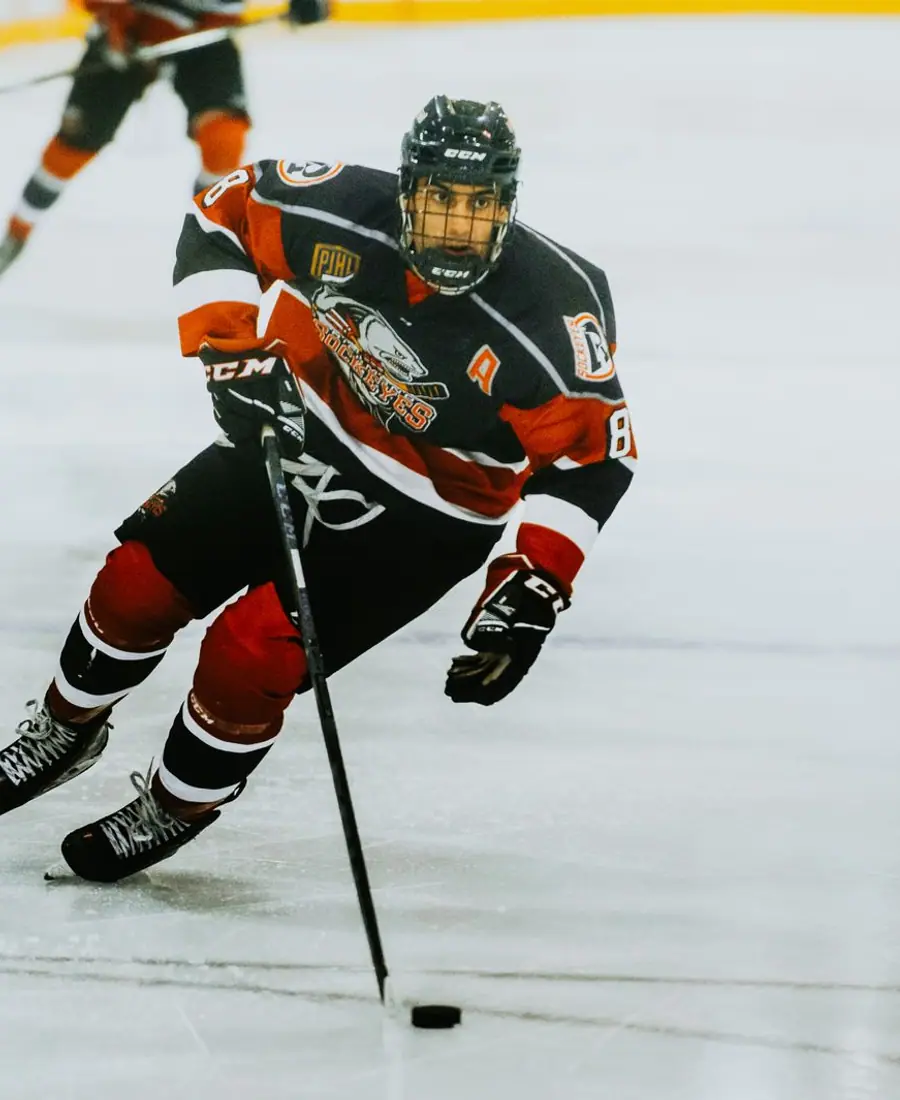
The shot that broke the penalty kill
There is a reason nearly every elite power play now runs a right-handed shooter in the left circle, or a lefty in the right, waiting to unload a one-timer. It is the most efficient scoring action in the sport, and it works because of physics, not flair.
A goalie can move fast, but he cannot teleport. When the puck travels cross-ice, the goalie has to slide from one post to the other while squaring up to a shot that is released the instant the pass arrives. The one-timer removes the catch-and-shoot delay that would otherwise give him time to get set. The puck simply changes direction toward the net faster than a human can reposition.
How the 1-3-1 manufactures the look
The setup does not just hope the pass gets there. It manipulates the four penalty killers until it does.
- The net-front player screens the goalie and occupies a defender, so the goalie cannot track the pass cleanly.
- The bumper in the slot forces the killers to respect the middle, freezing them in place.
- The point player and the wall player pass back and forth to make the killers rotate, and rotation creates the seam.
A one-timer goal almost never comes from the first pass. It comes from the fourth or fifth, once the box has been pulled a half-step out of shape.
The whole formation is a machine for producing one clean cross-ice lane for a fraction of a second. The shooter's only job is to be loaded and ready when it opens.
Why the off-wing matters
Put a right-handed shooter in the left circle and his stick blade is already open to the net. A cross-ice pass from the right side arrives on his forehand at the perfect angle to be redirected on goal without any adjustment. Flip the handedness and the shooter would have to reach across his body, killing the whole point of the play. Handedness is not a detail here. It is the design.
Beating it, and why that is hard
Penalty kills fight the one-timer by taking away the pass, not the shot. An aggressive killer will sprint at the passer to force a rushed feed, or a defender will lie down in the lane to block it. Both are gambles. Overcommit to the seam and the bumper is suddenly alone in the slot. Respect the bumper and the seam reopens.
That is why the setup endures. It does not rely on one unstoppable option. It forces the kill to choose which good option to give up, then punishes the choice. Understand that, and the power play stops looking like a shooting drill and starts looking like a trap being sprung in slow motion.