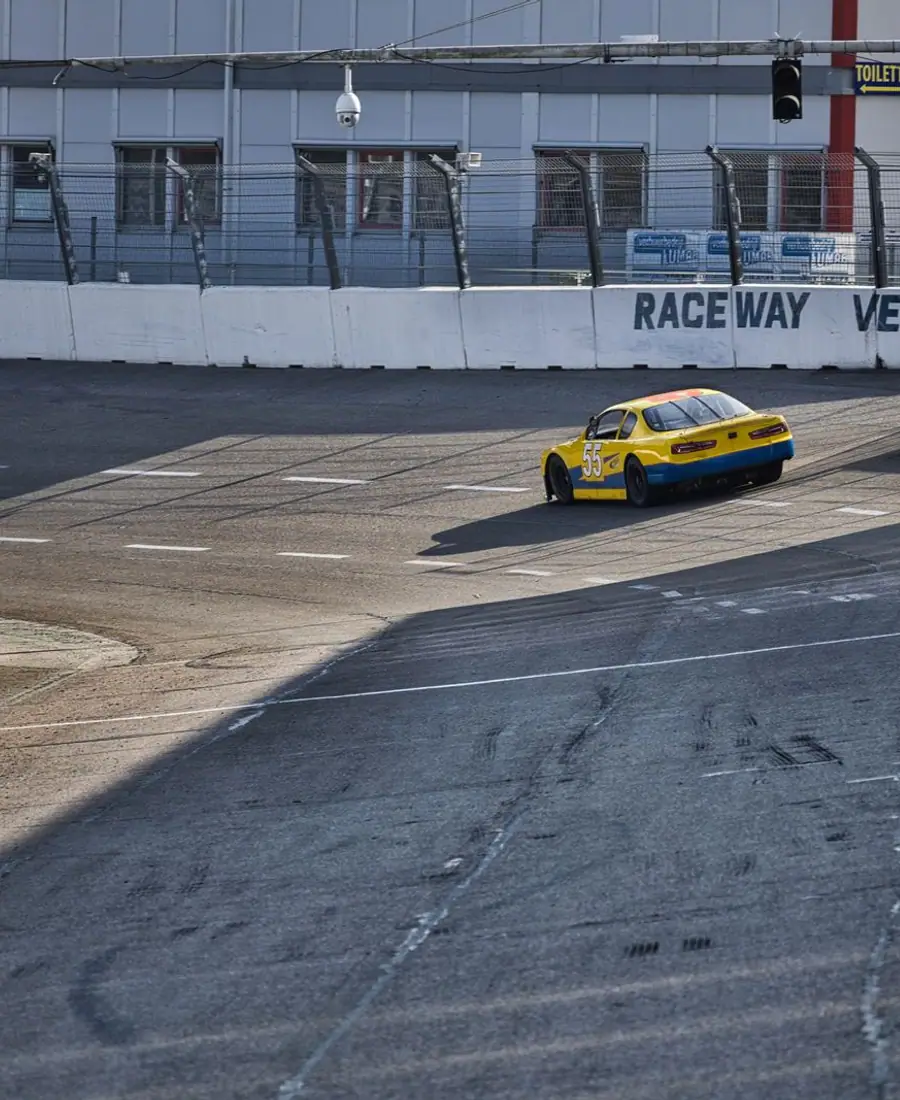
Strapped into a stock car at speed, a driver is nearly blind. High doors, a full cage, a helmet, and no rearview certainty mean he often cannot see the car inches off his door. The person solving that problem stands on the roof of the grandstand with a radio, and on the right day he is worth as much as any part on the car. Meet the spotter.
The core job: be the eyes
The spotter's baseline duty is spatial awareness. From a high vantage point he tracks his driver relative to everyone else and feeds a constant, minimal stream of information:
- "Clear." Nobody there, you can move.
- "Inside" or "outside." A car is alongside on that side, do not move over.
- "Two wide, three back." The traffic picture behind, so the driver knows what is developing.
The language is deliberately spare. At 200 miles per hour there is no time for sentences, so the best spotters develop an economy of words with their driver that borders on telepathy. One clipped syllable at the right instant prevents a wreck.
A great spotter says less than a good one. The fewer words, the faster the information lands, and speed of information is the whole job.
The early-warning system
Beyond blind spots, the spotter sees trouble before the driver can. A wreck unfolding in turn three, a car spinning up ahead, debris on the racing line, the spotter calls it while the driver is still a straightaway away, buying the fraction of a second that separates a clean escape from being collected.
This is most vital at superspeedways, where the pack runs inches apart and a single check-up can trigger a chain-reaction crash. The spotter's call of "high" or "low" to thread a driver through a blossoming wreck is often the difference between finishing and going home in pieces.
The tactical brain
On the biggest tracks, the spotter graduates from safety to strategy. In the draft, he can see the whole board, which lanes are moving, where the runs are forming, which alliance is coming, and he becomes a real-time tactician.
- "The outside is coming, block it."
- "Stay committed to the bottom, we've got a push."
- "Third lane forming, go now."
Superspeedway spotters coordinate with each other almost like a second layer of drivers, arranging pushes and lane changes for cars that cannot see well enough to arrange them alone. A driver with an elite plate-track spotter has an edge the timing screen never shows.
The relationship is everything
What makes a spotter great is not just eyesight, it is fit with the driver. Some drivers want constant chatter for reassurance. Others want silence until it matters and treat every word as a signal. A mismatched pairing produces either information overload or dangerous quiet. The best partnerships are long-running, built on thousands of laps of shared shorthand and mutual trust.
The spotter never touches the car, never turns a wrench, never feels the wheel. He stands on a roof with a radio and a pair of eyes, and he keeps a nearly blind driver safe and informed at nearly the speed of sound. It is one of the most demanding jobs in the sport, and one of the most invisible, right up until the moment his voice saves the day.