
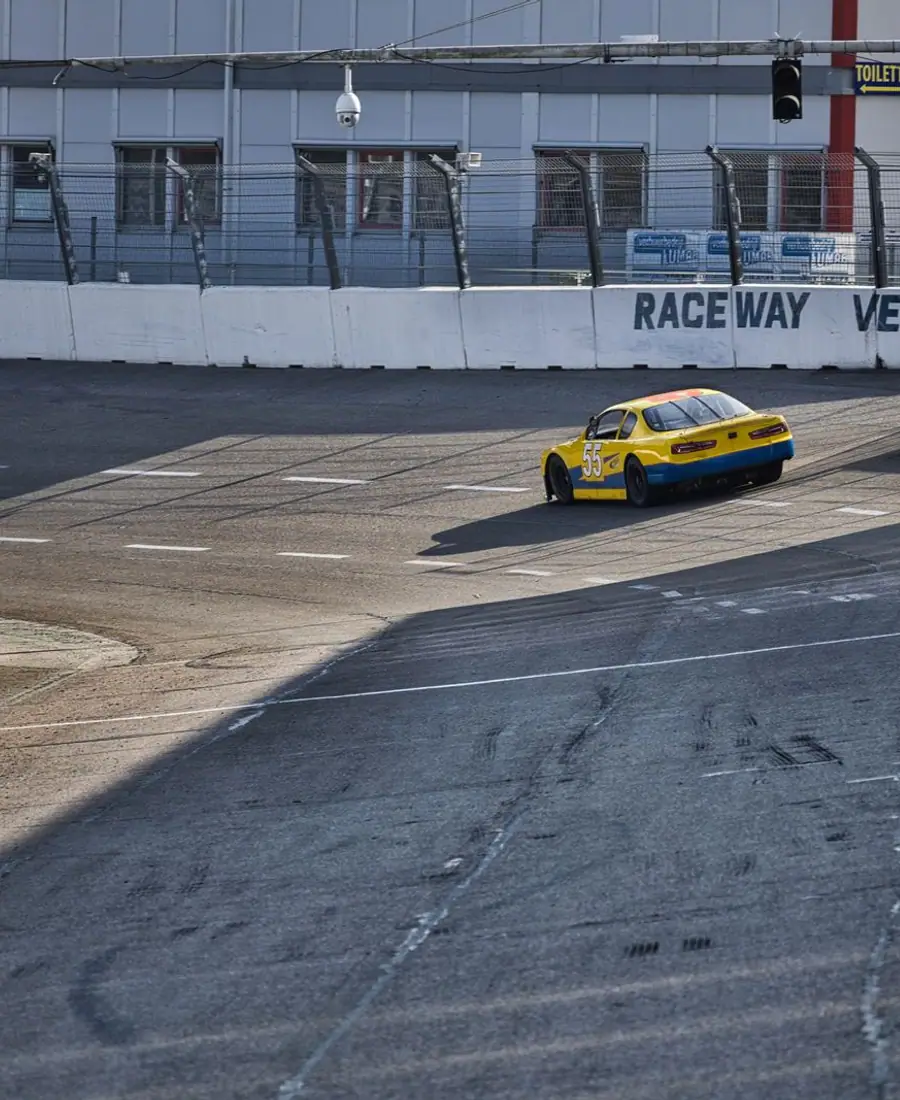
Short tracks are the sport's honesty test. There is nowhere to hide, no draft to save you, no long straight where horsepower papers over a bad corner. At Martinsville and Bristol, you are exposed lap after lap, and the drivers who thrive there share one skill that does not show up on a stat sheet: they roll the center.
What "rolling the center" means
A corner has three phases: entry, center, and exit. Amateurs obsess over entry, braking as late as possible and diving to the bottom. It looks fast and feels heroic. It is also slow, because a car hauled down hard and turned sharply scrubs speed and abuses the front tires.
Rolling the center is the opposite instinct. You brake earlier and softer, get the car rotated, and carry minimum speed through the middle that is as high as possible. The goal is a smooth arc, not a sharp point. The driver who carries five extra miles per hour through the center of a flat corner beats the diving driver out of it every single time, without touching the throttle harder.
Short-track speed is not made at the corner you can see. It is made in the middle, where nothing looks like it is happening.
Why patience is a weapon
Martinsville is a half-mile paperclip, essentially two hairpins connected by short straights. The brakes glow, the tires fade, and the temptation is to force the issue. But the car ahead is a rolling roadblock, and shoving it just wrecks both of you or flat-spots your tires.
Great short-track racers race the run, not the lap. They know a caution is always coming, and they would rather sit on a bumper for twenty laps, saving their stuff, than throw a desperate slide job that ruins their tires and their track position. The bump-and-run exists, but the masters use it as punctuation, not as a whole sentence.
The tire-management layer
Everything above is really one thing: tire management. On a short track you turn the same corner hundreds of times, and grip falls off steadily. The center-rolling driver preserves the front tires by not overloading them on entry, which means his car still turns at lap 400 while the diver is plowing up the track, unable to make the corner.
Watch a long green-flag run at a short track and you will see the field sort itself by discipline:
- The early leaders who abused the tires drift backward.
- The patient center-rollers who saved their fronts come forward.
- The last twenty laps become a referendum on who managed the first three hundred.
Why it is fading, and why it still matters
Modern aero and heavier cars have made this craft harder to see, and some fans mistake short-track struggles for boring racing. But the fundamental has not changed. The car that keeps its front tires alive and carries center speed still wins. It just requires more patience and more feel than the highlight reel rewards.
That is the quiet beauty of a short track. It does not care how brave you are on entry. It cares whether you can do the unglamorous thing, roll the center, save the tires, wait for the moment, five hundred times in a row.