
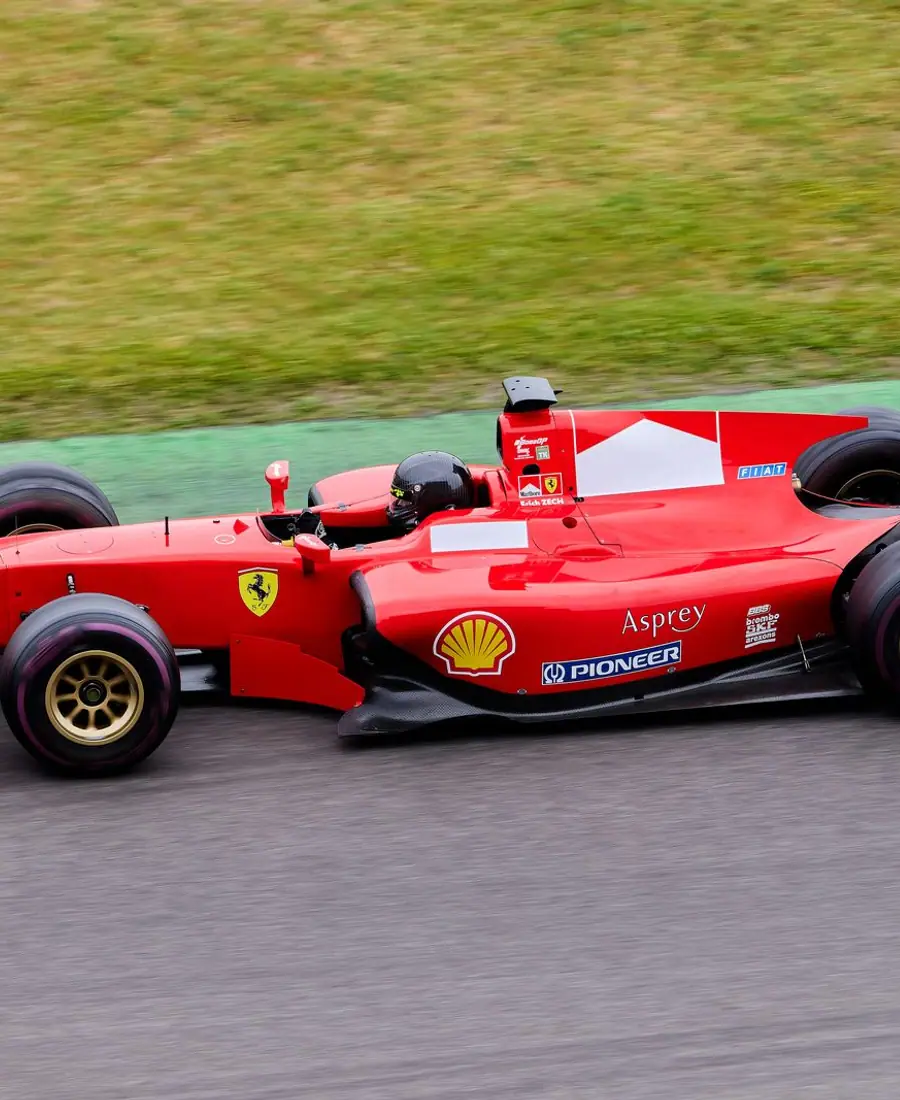
Watch a truly great wet-weather drive and it does not look reckless. It looks unhurried, almost gentle, as if the driver knows something the rest of the field does not. That impression is the whole point. Driving fast in the rain is not a test of courage so much as a craft — a set of learnable, brutally difficult skills that a handful of drivers execute better than anyone.
Grip becomes a thing you hunt for
In the dry, the fast line is largely fixed — the smoothest arc through a corner, worn shiny and grippy by thousands of laps. In the wet, that same racing line becomes the worst place to be. Rubber laid down over a dry weekend turns slick and treacherous when wet, so the grip hides off-line, on the rougher, less-used tarmac.
The great wet drivers deliberately abandon the conventional line, braking and turning where the surface has more texture. It looks wrong to a trained eye, which is exactly why it works. They are not following a line; they are reading the road.
Everything happens more slowly, and that is the skill
The defining feature of a wet lap is smoothness. Every input — brake, steering, throttle — must be fed in gradually, because a sudden movement asks more of the tyre than the film of water beneath it can provide. Snap at the controls and the car simply lets go.
In the rain, the fastest drivers are almost always the smoothest. Aggression is not speed; it is a spin waiting to happen.
This is why wet driving rewards patience over bravado. The driver who wins is the one who can sense the exact edge of available grip and hold the car just inside it, lap after lap, without the twitch that ends a race in the barriers.
Reading the water
Beyond feel, there is anticipation. Standing water pools in predictable places — the inside of corners, dips in the track, the run-off where drainage struggles. Hit a puddle at speed and the tyre climbs onto the water and loses contact entirely; the car aquaplanes, and for a moment the driver is a passenger.
Elite wet drivers map these hazards constantly, adjusting their line to skirt the deepest water and picking their braking points to avoid asking for grip precisely where there is none. Much of their apparent calm is really foresight — they are avoiding problems the rest of the field only discovers on arrival.
Why so few master it
The reason wet-weather ability is so prized is that it cannot be bought with car performance. Downforce and power matter far less when the limiting factor is a slippery surface. What matters is the driver's feel, their willingness to trust an unconventional line, and their discipline to stay smooth when instinct screams to react.
That is why a wet race can scramble the order so dramatically, lifting an ordinary car to the front and exposing a fast one whose driver cannot read the conditions. Rain does not just change the track. It changes what the sport is measuring — and hands the advantage to whoever has quietly mastered the art of finding grip that is barely there.