
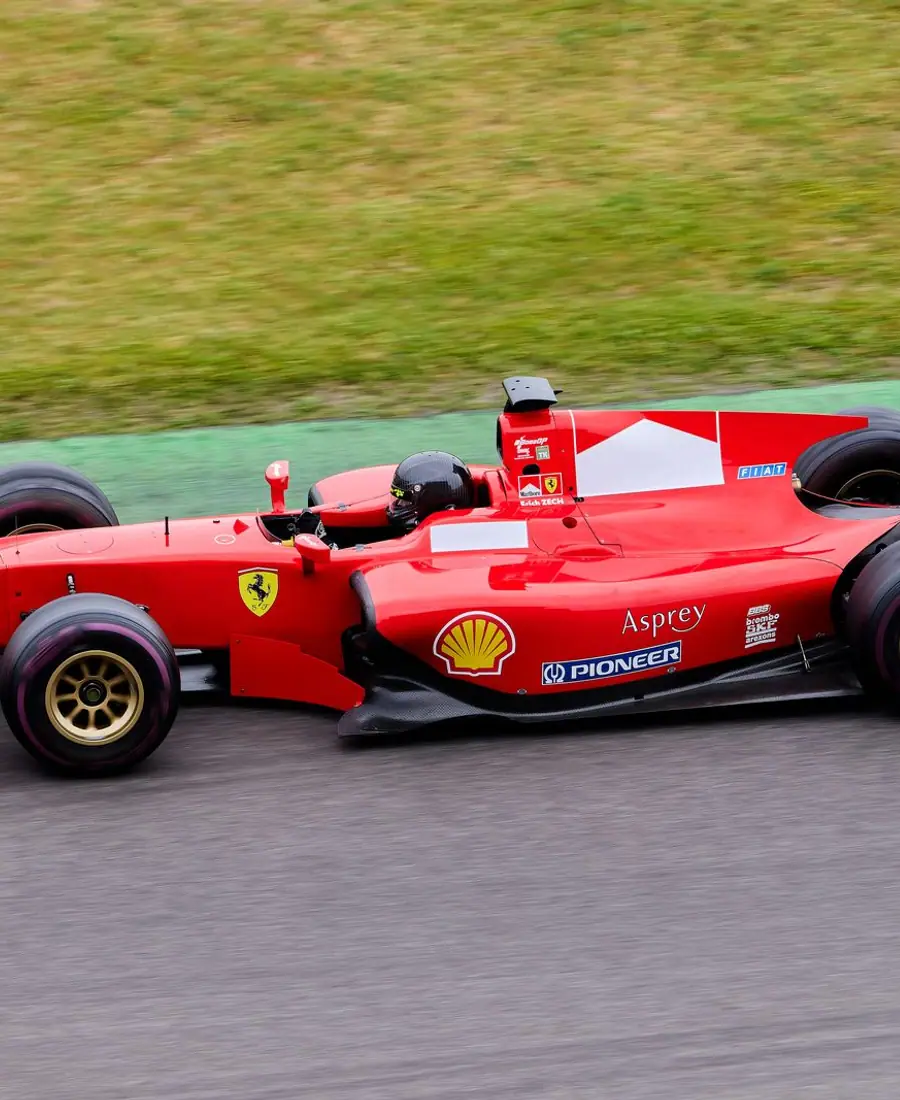
You can tell an F1 era by its sound. The demented shriek of a naturally aspirated V10, the flat blare of a V8, the muted, complex hum of a turbo-hybrid — each is the audible signature of a completely different engineering philosophy, and each reshaped the sport around it.
The naturally aspirated peak
For decades, more revs meant more power, and engines climbed toward an almost absurd ceiling. The V10 era produced motors that spun to eighteen thousand revolutions a minute and beyond, screaming to a pitch that set car alarms off in the grandstands.
These engines were peaky and unforgiving. Power arrived in a narrow band high in the rev range, so drivers lived on the throttle, keeping the engine singing. The reward was a raw, linear connection between right foot and rear wheels. The cost was thirst and fragility.
The V8 discipline years
When the sport standardised on smaller V8s with a rev limit, the game shifted. Power outputs were reined in, and the engineering war moved elsewhere — to aerodynamics, to tyre management, to the fine art of extracting lap time from a frozen formula.
Drivers found a more usable, if less thrilling, power delivery. The V8 years were quietly a golden age of chassis and aero development precisely because the engine was locked down and everyone poured their ingenuity into the rest of the car.
The turbo-hybrid revolution
Then came the biggest conceptual leap in modern F1: the turbo-hybrid. A smaller turbocharged engine paired with energy recovery systems that harvest waste heat and braking energy, store it, and redeploy it as electrical power.
Suddenly a lap was not just about combustion. It was about energy management — how you harvested, how you deployed, how you balanced electrical boost against fuel load across an entire stint. Thermal efficiency, the share of fuel energy actually turned into forward motion, climbed to levels road-car engineers had once thought impossible.
The turbo-hybrid turned the driver into an energy manager as much as a racer, thinking in joules as well as corners.
What each era demanded of the driver
The throughline is that engines never just made power — they dictated behaviour.
- The V10 rewarded aggression and rhythm, keeping revs high.
- The V8 rewarded precision within tight limits.
- The turbo-hybrid rewards intelligence: managing deployment, saving fuel, and lifting-and-coasting to hit targets while still racing.
As the sport moves toward greater electrical power and fully sustainable fuels, the pattern holds. Every new power unit is not just a new heart for the car; it is a new set of demands on the person driving it, and a new definition of what mastery even means. Listen closely and the engine still tells you what the sport values most in any given age.